Company will showcase highly accurate and reproducible plaque analysis as well as biointegrated FFR-CT data1 to identify lesion-level risk and enable patient-level impact
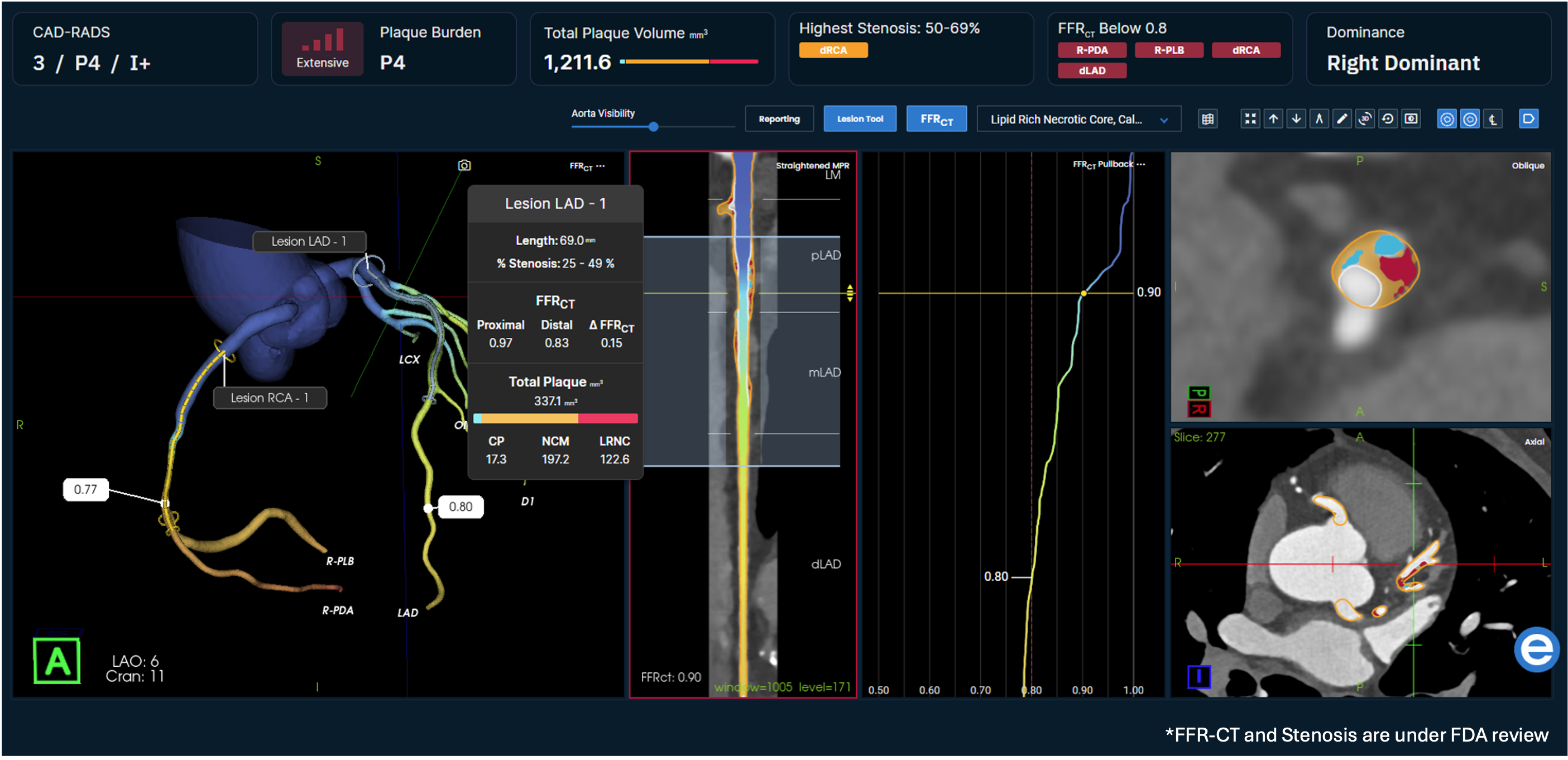
BOSTON–(BUSINESS WIRE)–#CTfirst—Elucid, an innovator in AI-powered coronary CT angiography (CCTA) analysis, today announced its largest and most comprehensive presence to date at the Society of Cardiovascular Computed Tomography Annual Scientific Meeting (SCCT 2026), taking place July 9 – 12, 2026, at the Gaylord Pacific Resort & Convention Center in Chula Vista, Calif. During the meeting, Elucid will unveil its next generation of innovation, including plaque based FFR-CT2, stenosis quantification2, and a new comprehensive user interface that enables efficient and transparent clinical insights. Across meeting proceedings, the company will present scientific and clinical cases that demonstrate its leadership in CCTA 3.0, the company’s vision of the future of CCTA-guided, personalized coronary artery disease (CAD) care.

“We are standing at an inflection point in cardiovascular medicine, on the cusp of CCTA 3.0 and moving from population-based guidelines to truly personalized therapy,” said Elucid CEO Kelly Huang, PhD. “Oncology made this shift over the past decade, evolving from a one-size-fits-all approach based on tumor size (anatomy) to highly personalized care driven by detailed biological characteristics and physiology of tumor behavior. Elucid’s vision is to drive a similar evolution in cardiovascular disease. At SCCT, we will demonstrate how we plan to deliver accuracy, reproducibility, and complete transparency in integrating anatomy, biology, and physiology, and how we are investing in the clinical science that will make CCTA 3.0 a reality.”
As vasodilatory function is impacted by plaque amount and composition, Elucid developed deep learning AI models that leverage its histology-based plaque quantification to estimate FFR-CT2. Elucid’s FFR-CT is validated against invasive FFR, and under review by FDA. This biointegrated approach to FFR-CT uniquely enables continuous estimation of numerical FFR-CT along the entire vessel tree in a manner that is transparent and is always concordant with plaque characterization. Additionally, Elucid offers the only CT-derived plaque analysis validated for use in the carotid arteries.
“The next frontier in coronary CT is not simply detecting disease but also measuring the biological and physiological features that determine how that disease behaves,” said Dr. Amir Ahmadi, MD, FACC, FSCCT, clinical associate professor of Cardiology at the Icahn School of Medicine at Mount Sinai and Elucid’s lead scientific advisor. “New data being presented at SCCT demonstrate that Elucid achieves excellent performance in the accurate, reproducible, and transparent quantification of plaque composition, as well as stenosis2, and plaque-derived FFR-CT1. This enables risk assessment at the level where events originate — the individual lesion — while integrating that information with vessel-level plaque burden to define personalized, patient-level risk. The goal is to translate reliable imaging data into more precise therapy and improved patient outcomes, all while improving workflow efficiency for physicians.”
Elucid’s SCCT 2026 sessions and events include:
Thursday, July 9:
12:30 – 5:30 pm | AI & Innovation Symposium “CCTA 3.0: Precise Personalized Guidance, Accelerated by Agentic AI.” Speaker: Ruby Gill, PhD. Elucid’s session will explore how artificial intelligence and machine learning are accelerating the translation of comprehensive plaque data into precise, individualized clinical guidance.
5 – 8 pm | Workshop Dinner “CCTA 3.0: HANDS-ON EXPERIENCE | Integrating Plaque Biology and Plaque-Derived FFR-CT for Lesion-Level Risk Assessment.” Speakers: Amir Ahmadi, MD; Jairo Aldana-Bitar, MD; Farhan Katchi, MD; Adam Jacobi, MD. An immersive, hands-on session in which attendees will work directly with Elucid’s platform to explore the integration of plaque biology and plaque-derived FFR-CT for comprehensive lesion-level risk assessment. Register here: https://scct.org/events/register.aspx?id=2063525
Friday, July 10:
12:50 – 1:10 pm | Product Showcase (Exhibit Hall) “CCTA 3.0: ANALYSIS | From Individual Lesions to Patient Risk: A Comprehensive Assessment.” Speaker: Jairo Aldana-Bitar, MD. Elucid will participate in SCCT’s inaugural Product Showcase with a focused 20-minute demonstration of how the company’s integrated platform bridges individual lesion data and holistic patient risk assessment.
3:30 – 3:45 pm | Non-Sponsored Session: AI-Plaque Wars. Speaker: Amir Ahmadi, MD. Dr. Ahmadi will represent Elucid in this panel on its CCTA 3.0 vision, including the evolution from CCTA 1.0 through 2.0 to 3.0, and the scientific approach and case for deriving both plaque characterization and FFR-CT from the same histology-based data, enabling physiologic assessments that are informed by and directly linked to plaque biology.
5:22 – 5:34 pm | Novel Technology Session | Chula Vista 4 “CCTA 3.0 | Delivering on Next-Level Scientific Innovation and Patient Outcomes.” Speaker: Kelly Huang, PhD. In a 12-minute featured presentation, Elucid CEO Kelly Huang, PhD, will articulate Elucid’s comprehensive CCTA 3.0 platform strategy, from CT-Virtual Histology and plaque-derived FFR-CT to prospective clinical trials and next-generation physician workflows.
Saturday, July 11:
12:50 – 1:40 pm | Lunch Symposium | Chula Vista 2 “CCTA 3.0 | Remove the Blindfold: Integrating Plaque Biology and Plaque-Based Physiology for Smart Clinical Decisions.” Speakers: Amir Ahmadi, MD, Michael Hadley, MD, Anton Camaj, MD. Through clinical evidence, real-world cases, and emerging research, this session explores how plaque biology and plaque-derived physiology can support more informed decisions and better understand risk, guide treatment, and improve patient outcomes.
About Elucid
Elucid is a Boston-based AI medical technology company that develops AI to see invisible features of risk. The company is dedicated to developing a clinical platform to help physicians deliver CCTA-guided personalized care by providing a more precise view of atherosclerosis, the root cause of cardiovascular disease. The company’s FDA-cleared Plaque-IQ™ image analysis software is designed to help physicians prioritize and personalize treatment based on actual disease, rather than population-based risk of disease. Plaque-IQ equips physicians with critical information regarding the type and amount of plaque in arteries that can lead to heart attack and stroke. Elucid is also pursuing an indication for FFR-CT, derived from its plaque algorithm, resulting in concordance between plaque and FFR-CT. FFR-CT helps physicians identify coronary blockages and the extent of a patient’s ischemia non-invasively. For more information, visit elucid.com.
References
1 FFR-CT data being presented at SCCT is based on research product.
2 FFR-CT and stenosis are under FDA review.
Contacts
Media Contact:
Sam Choinski
Pazanga Health Communications
[email protected]
(860) 301-5058