
The Kiaura Collection™, built with Cognetic Technology™, designed and invented by Aaron DeJule, challenges traditional assumptions about sitting and explores how responsive movement can support human performance and comfort across the healthcare experience.
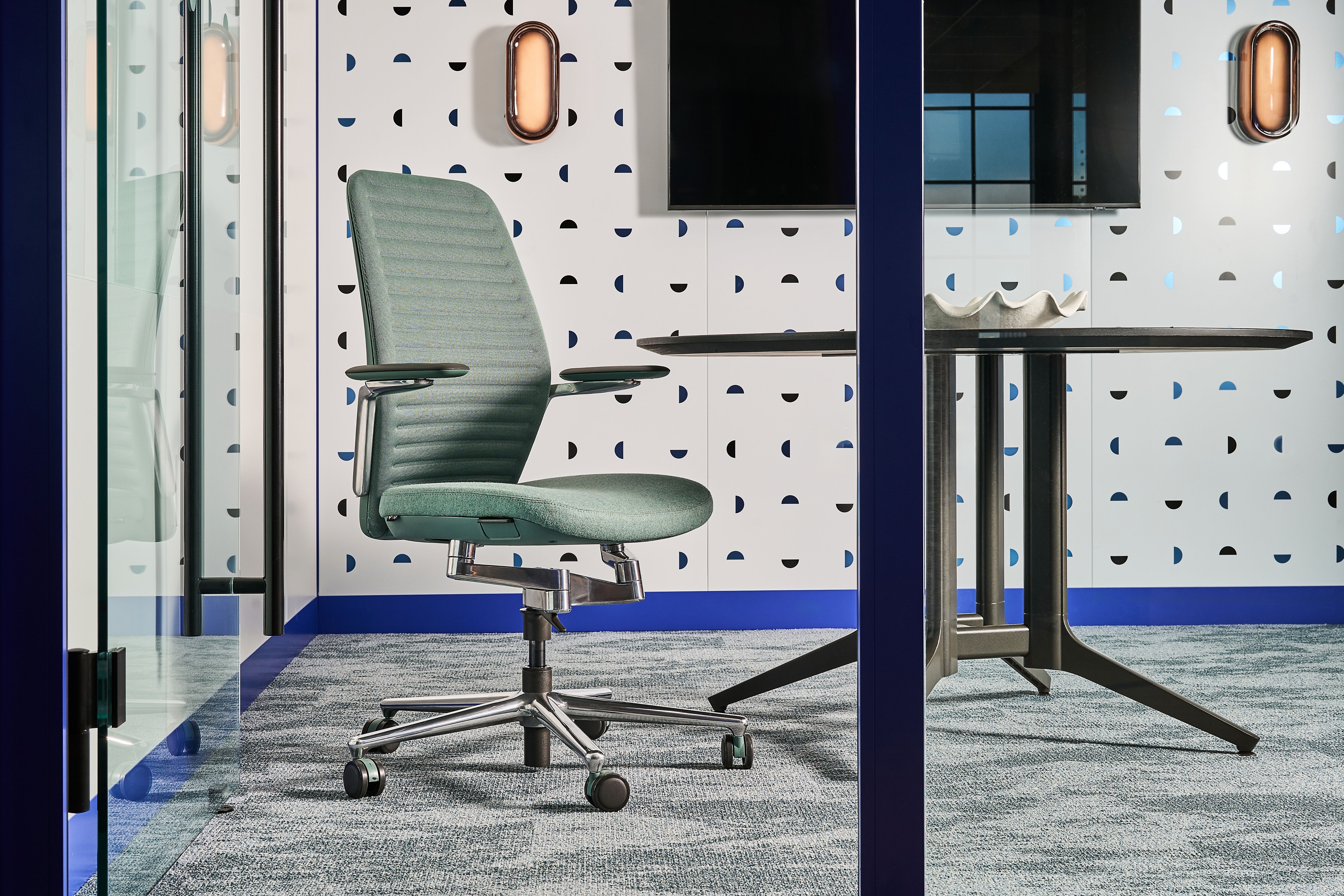

GREEN BAY, Wis.–(BUSINESS WIRE)–For decades, the seating industry has approached discomfort as something to manage. Chairs have become increasingly sophisticated, adding controls, adjustments, and ergonomic features designed to help people tolerate long periods of sitting.
But one assumption largely remained unchanged: sitting itself is relatively static.
KI is challenging that assumption with the Kiaura Collection™, built with Cognetic Technology™, designed and invented by Aaron DeJule, centered around a different perspective: What if seating could flow with the body’s natural movement, rather than simply supporting a stationary posture?
The answer to that question lies in what KI defines as Human Performance Seating, a new approach to seating that considers how movement can influence the way people feel and function throughout the day.
For healthcare interior designers, the concept offers another lens through which to consider the human experience of care, particularly as healthcare environments increasingly account for behavioral health, staff well-being, flexible work, and the physical and emotional needs of patients, families, and caregivers.
Rethinking what happens when people sit
Invented by DeJule, Cognetic Technology is a patented, gravity-driven, multi-axis motion system that responds to the body’s natural center of gravity, enabling subtle, responsive movement while seated. The Kiaura Collection, also designed by DeJule, is the first seating collection built with Cognetic Technology and includes a coordinated family of task, conference, and lounge seating, along with complementary tables and ottomans.
Rather than asking users to constantly adjust a chair to find a comfortable position, Cognetic Technology responds naturally to the body as it moves.
“The traditional approach to seating design has been to merely make sitting more manageable,” said Juan Matta, research manager at KI. “But, we aren’t designed for stillness and sitting — our bodies and brains are designed for movement. As such, we are exploring what happens when we stop treating movement as something that needs to be eliminated from the seated experience and instead designed for it.”
From movement to human performance
Years of prototyping and observation informed the development of Cognetic Technology, followed by research exploring the relationship between movement, comfort, focus, and overall well-being. These efforts revealed how responsive movement, while seated, may influence physical comfort, cognitive performance, and the overall seated experience.
Early controlled studies associated with Cognetic Technology found measurable differences across several areas of seated performance and wellness. In one four-hour seated study, participants experienced reductions in anxiety, improvements in visual and auditory cognitive processing, and reduced lower-back and pelvic discomfort during extended seated sessions.
These findings add another dimension to the conversation around ergonomics. Rather than viewing seated comfort solely through the lens of posture and support, Human Performance Seating considers the relationship between movement, physical comfort, cognitive engagement, and how people function over time.
“The research helped reinforce something we already suspected from observing people interacting with the technology: movement improves our performance,” Matta said. “The opportunity is to help our design partners and customers see the proof of what movement introduced into the seated constraint we face during work does for our bodies, our minds, and our biology.”
Why movement matters in healthcare
Healthcare environments contain countless moments in which patients, staff, and caregivers sit: waiting for an appointment, meeting with a clinician, working between patient visits, completing administrative tasks, consulting with colleagues, supporting a family member, or taking a moment to recharge.
As healthcare design increasingly considers the physical, cognitive, and emotional experience of patients and staff, those moments of sitting can become part of a larger conversation about how environments support human performance.
Human Performance Seating offers healthcare designers a new way to think about spaces where people may spend meaningful amounts of time seated, including staff workspaces, administrative environments, behavioral health settings, and other areas where comfort, focus, and engagement matter.
“Healthcare is asking us to think more holistically about the people who occupy these environments,” said Trish Fedel, director of healthcare markets for KI. “That includes patients and families, but it also includes the people delivering care and the people working behind the scenes. Human Performance Seating gives designers another way to consider how movement can better support people throughout the day.”
A platform for what comes next
The Kiaura Collection represents the first commercial application of Cognetic Technology, but KI sees the technology as a platform with potential to evolve. As the company continues to explore the relationship between movement and human performance, future applications could extend the underlying technology to additional furniture categories and environments.
For now, the Kiaura Collection provides a tangible demonstration of the concept: seating doesn’t have to be static to provide support.
At Healthcare Design Conference + Expo 2026, attendees can experience the Kiaura Collection and even visualize their movement with The Art of Flow, an interactive activity that tracks each guest’s unique “flow” and turns it into a colorful, one-of-a-kind visual.
“Kiaura is more than a new seating collection,” said Matta. “It is a different expectation for what seating can do for the body and brain over the course of a day. People can feel the difference almost immediately.”
The Kiaura Collection built with Cognetic Technology will be featured by KI at Healthcare Design Conference + Expo 2026, October 17–20, at the Ernest N. Morial Convention Center in New Orleans, Booth #1701. More information can be found at ki.com/healthcaredesign.
ABOUT KI
KI manufactures innovative furniture for education, healthcare, government, and corporate markets. The employee-owned company is headquartered in Green Bay, Wisconsin, with sales and manufacturing facilities worldwide. KI tailors products and service solutions to the specific needs of each customer through its unique design and manufacturing philosophy. For more information, visit ki.com.
ABOUT AARON DEJULE
Aaron DeJule is an industrial designer and founder of DeJule LLC, with a career spanning more than two decades focused on advancing the experience of seating. A graduate of the Institute of Design in Chicago, he has partnered with leading manufacturers to develop award-winning furniture and lighting solutions recognized with honors including IDSA Gold and NeoCon Gold and Silver. DeJule is the inventor of Cognetic Technology and designer of the Kiaura Collection, a new approach to seating that rethinks the relationship between movement, comfort, and performance.
INVENTOR & DESIGN ATTRIBUTION
Cognetic Technology™ is a patented seating innovation invented by Aaron DeJule, founder of DeJule LLC. The Kiaura Collection™, designed by Aaron DeJule, is the first seating collection built with Cognetic Technology and is exclusively manufactured by KI.
Contacts
MEDIA CONTACT
Stephanie Smith
262-290-7745
[email protected]
