
Survey of 1,000 women points to access barriers, low awareness and cost uncertainty as factors that can stand between women and screening
MARLBOROUGH, Mass.–(BUSINESS WIRE)–Hologic, a global leader in women’s health, today released a new survey1 revealing that more than one in three U.S. women (37%) aged 35–75 have skipped or delayed a recommended* mammogram.
Among women who skipped or delayed a recommended mammogram, four in 10 went more than two years without a mammogram. When women who were overdue were asked what would most motivate them to get screened, nearly one in four pointed to a direct recommendation from their doctor, highlighting the important role healthcare providers play in encouraging screenings.
“These findings show that what stands between a woman and a potentially lifesaving mammogram is rarely a single obstacle. More often, it’s a missed reminder, a conversation that never happened or uncertainty about which screenings she needs and what they may cost her,” said Jyoti Gupta, Ph.D., CEO of Hologic’s Breast and Skeletal Health Solutions business. “With breast cancer outcomes so closely tied to early detection, I encourage every woman to ask her healthcare provider which screenings are right for her and to make that appointment a priority.”
Breast cancer is the most common cancer diagnosed among women in the U.S.2 It has a 99% survival rate when caught at an early, localized stage,3 underscoring the importance of regular screening. Yet the survey, conducted by Hologic among 1,000 women, identifies several gaps that can stand between women and regular screening:
- Provider engagement. Half of women do not routinely see an OB-GYN, while one in five women (20%) who are eligible and have never been screened say they have never been told they need a mammogram.
- Reminders. Twenty-one percent of women say getting a recommended mammogram is not top of mind.
- Costs. More than one-third of survey respondents (36%) do not know or do not believe that preventive screening mammograms are covered under most insurance plans at no cost.
- Transportation and other barriers. Among women facing transportation barriers, 59% have skipped a mammogram, compared with 31% of those who do not face those barriers. Similar gaps emerge among women experiencing housing instability (57% vs. 33%, respectively) and food insecurity (56% vs. 29%).
- Radiation concerns. Forty-three percent of women surveyed believe, or are unsure whether, mammograms expose them to dangerous levels of radiation. In reality, a standard screening mammogram exposes a patient to 0.4 mSv of radiation.4 This is about the amount an average person gets from natural sources over 1–2 months.
Major gaps in women’s understanding of breast density also persist, despite recent efforts to increase education and awareness around this topic, including standards from the U.S. Food and Drug Administration (FDA) that require mammography facilities to notify patients about breast density.
- Fifty-seven percent of survey respondents do not know that having dense breasts increases their risk of breast cancer, and nearly two-thirds of women (66%) believe dense breasts can be detected by touch.
- Gaps continue after screening: 37% of women who have had a mammogram say they did not have a meaningful conversation about their breast density following their most recent screening, while 40% of women with dense breasts say they were never recommended additional screening.
The survey findings underscore the need for clear, accessible education about breast cancer screening, including information about when to get screened, what preventive screening may cost and how to separate facts from common misconceptions.
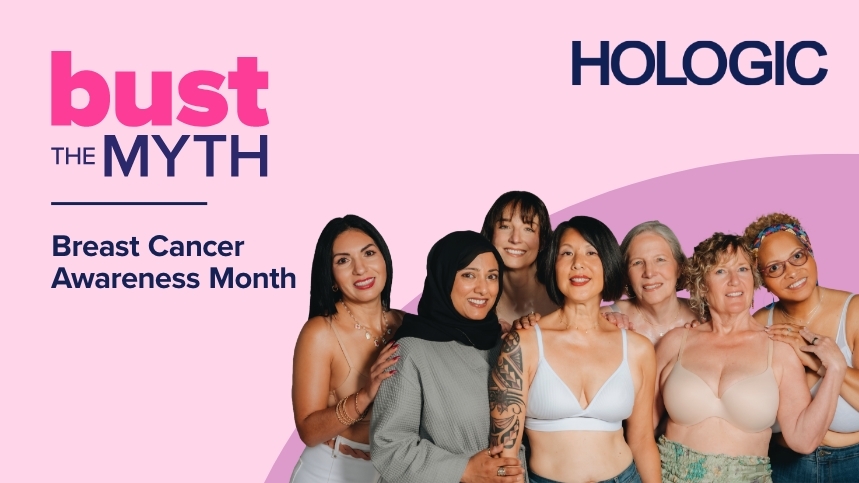
To help address these needs, Hologic is continuing its #BustTheMyth patient education campaign for the third consecutive year. The campaign shares relatable, fact-based information about breast cancer, breast density and screening through social and traditional media, informational emails, videos, educational materials, posters for doctors’ offices and other channels. It features real women from around the world and aims to help women feel more informed and confident about their breast health.
To learn more about common breast cancer screening myths and facts, visit Hologic.com/BustTheMyth or follow #BustTheMyth on social media.
About Hologic, Inc.
Hologic, Inc. is a global leader in women’s health dedicated to developing innovative medical technologies that effectively detect, diagnose and treat health conditions and raise the standard of care around the world. To learn more, visit www.hologic.com and connect with us on LinkedIn, Facebook, X, Instagram and YouTube.
Forward-Looking Statements
This news release may contain forward-looking information that involves risks and uncertainties, including statements about the use of Hologic products. There can be no assurance these products will achieve the benefits described herein or that such benefits will be replicated in any particular manner with respect to an individual patient, as the actual effect of the use of the products can only be determined on a case-by-case basis. In addition, there can be no assurance that these products will be commercially successful or achieve any expected level of sales. Hologic expressly disclaims any obligation or undertaking to release publicly any updates or revisions to any such statements presented herein to reflect any change in expectations or any change in events, conditions or circumstances on which any such data or statements are based.
Hologic and The Science of Sure are trademarks and/or registered trademarks of Hologic, Inc. and/or its subsidiaries in the United States and/or other countries.
References
*A mammogram they understood to be due, either based on a doctor’s recommendation or their own awareness of screening guidelines.
1 The survey was conducted online from August 14 to August 31, 2026, among a national sample of 1,000 U.S. women aged 35 to 75, recruited via the Dynata opt-in online research panel. The sample includes a general population component and a separately recruited oversample of rural women, merged prior to analysis. Data were weighted using iterative proportional fitting to U.S. Census Bureau population estimates from the American Community Survey (ACS) 2022 5-Year Estimates, restricted to women aged 35 to 75. Weighting parameters were age, race and ethnicity, educational attainment, and census region. Under the simplifying assumption that respondents were randomly selected from the target population with an estimated non-zero chance of selection, the modeled sampling error for a sample of this size would be approximately ±3.5 percentage points at the 95% confidence level.
2 American Cancer Society. Breast cancer facts & figures. Cancer.org. 2024. https://www.cancer.org/research/cancer-facts-statistics/breast-cancer-facts-figures.html.
3 American Cancer Society. Survival rates for breast cancer. www.cancer.org. March 1, 2023. https://www.cancer.org/cancer/types/breast-cancer/understanding-a-breast-cancer-diagnosis/breast-cancer-survival-rates.html.
4 American Cancer Society. What Is a Mammogram? | Breast Cancer Screening. www.cancer.org. January 14, 2022. https://www.cancer.org/cancer/types/breast-cancer/screening-tests-and-early-detection/mammograms.html.
Contacts
Media Contact
Bridget Perry
Senior Director, Corporate Communications
(+1) 508.263.8654
[email protected]
