
Michigan woman living with motor neuron disease uses brain activity to generate her own words, answer open-ended questions, and communicate with family using the fully implanted intracortical BCI
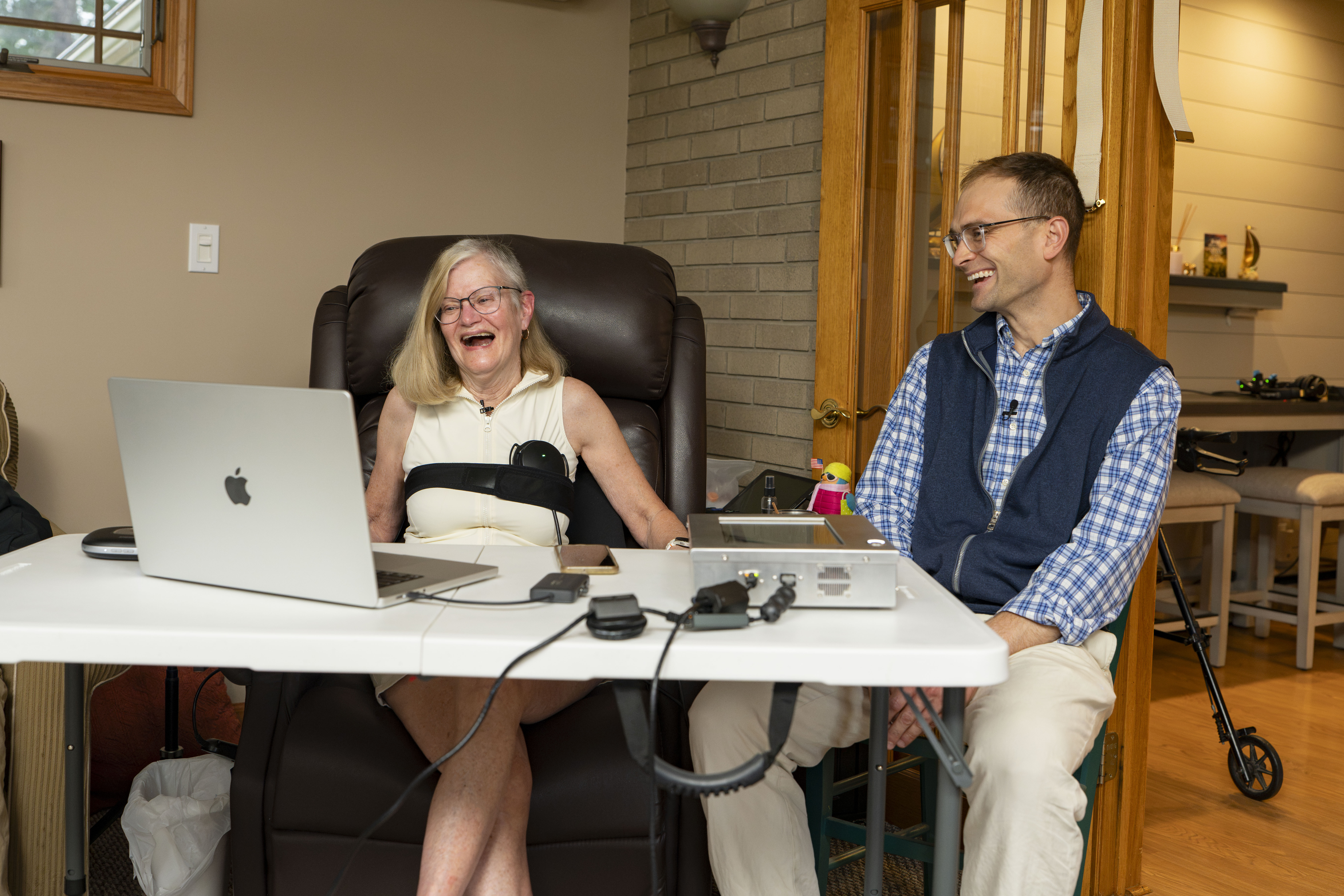
AUSTIN, Texas–(BUSINESS WIRE)–Paradromics Inc., a neurotechnology company developing a high-data-rate brain-computer interface (BCI) platform designed to restore and enhance human capabilities, today announced that the first participant implanted with the Connexus® BCI has successfully used the system for real-time speech and text communication. The milestone was achieved as part of the Connect-One Early Feasibility Study, conducted under an FDA-approved Investigational Device Exemption (IDE). Moving beyond researcher-selected copy tasks, the participant chose her own words, answered open-ended questions, and communicated with her grandchildren during a live phone call. The demonstration establishes a real-time communication loop in which neural activity associated with speech is decoded into language and returned to the participant as text and synthesized speech.

Data from the first participant also show that Paradromics has identified distinct patterns of neural activity associated with both attempted speech, when a person tries to produce speech, and imagined speech, when a person internally generates language without physically attempting to speak. These findings demonstrate a path toward restoring communication while providing a broader view of the neural information accessible through high-resolution intracortical recording.
“When we implanted Connexus in June, we crossed the threshold into long-term human use. We have now crossed another: our first participant is choosing her own words and using neural activity to communicate them in real time,” said Matt Angle, PhD, founder and CEO of Paradromics. “She determines what she wants to say, and the system enables her to say it.”
The first participant is a Michigan woman in her 60s living with a progressive motor neuron disease that has significantly affected her ability to speak. Motor neuron diseases are a group of neurological disorders that affect voluntary movement and can impair speech, mobility, and other motor functions; they include conditions such as amyotrophic lateral sclerosis (ALS) and primary lateral sclerosis (PLS). She has severe dysarthria and retains limited speech, and while her husband can often understand her, communicating with others has become far more challenging.
When the system was activated for free speech, she chose a sentence that captured both her experience and the purpose of the study: “Okay, I have a lot to say.” The sentence was generated by the participant and decoded in real time exactly as she intended, with no errors.
Later, Matthew Willsey, MD, PhD, a University of Michigan Health neurosurgeon and Connect-One investigator, asked what she would say to a participant considering a BCI and this surgery. Through Connexus, she responded: “Don’t be afraid. It’s a wonderful experience to be able to help others by your participation in the research study.” The decoded output matched every intended word.
During the same session, the participant used the Connexus BCI to communicate with family members during a live phone call. She asked her grandchildren questions and responded using speech generated by the system.
Said Dr. Willsey, “The participant and the Paradromics team have achieved a major milestone by demonstrating the ability to speak freely through a fully implantable device designed for clinical use. Restoring communication may soon be available to others with diseases impacting the ability to speak.”
The Connexus BCI is designed to record neural activity at the resolution of individual neurons and transmit that information wirelessly through intact skin to the external computing system. Paradromics researchers are examining how neural activity changes as the participant listens to language, prepares to speak, attempts speech, and generates language internally. The data collected to date show that speech-related information can be identified across hundreds of neural recording channels and represented as distinct patterns that change depending on the task being performed.
Said Vikash Gilja, PhD, Chief Scientific Officer of Paradromics, “Across populations of individual neurons, we can see structure associated with listening, preparing to speak, attempted speech and imagined speech. Longitudinal data allow us to study where those states overlap, where they differ, how stable the information remains, and how the participant and decoder adapt to one another. Those insights will help us build communication that becomes more accurate and more natural for the person using it.”
Paradromics received FDA approval of an Investigational Device Exemption for the Connect-One Early Feasibility Study in November 2025. The study is led by David M. Brandman, MD, PhD, Lead Principal Investigator at UC Davis Health, with Daniel Rubin, MD, PhD, at Mass General Brigham Neuroscience Institute and clinical teams at University of Michigan Health participating across the three study sites.
“The very first participant implanted with the Connexus system has been empowered to say whatever she wants to say using her brain-computer interface,” said Dr. Brandman. “This is a landmark milestone for the field. I’m excited for what the future has in store for her and look forward to learning more about how the Connexus system can be used to help others.”
The observations also provide Paradromics with a new way to investigate the neural activity that precedes outward communication. People routinely formulate, rehearse, and refine language internally before deciding what they want to express. This internal language is often described as imagined speech, inner speech, or the inner voice.
Said Angle, “Part of the early feasibility study that we are undertaking is to better understand which brain areas handle different types of language information, and how best to use that information for restoring communication. This will help us understand what types of future patients would benefit from implants in what areas.”
“In the process of doing this,” continued Angle, “we are also building what is effectively the world’s most sophisticated conduit between human intention and AI. In the not-too-distant future, BCI users will be able to more effectively query and control AI models like the ones that many of us use every day.”
About Paradromics
Paradromics builds brain-computer interface (BCI) technologies for seamless human-technology integration, designed to restore and enhance human capabilities. The company’s first-generation device, the Connexus® BCI, is designed to capture neural activity at the resolution of individual neurons and translate neural intent into speech, computer control, movement, and other essential human functions. Paradromics’ first clinical application focuses on restoring communication for people who have lost the ability to speak due to paralysis and other severe motor impairments. Over time, the platform is designed to support direct AI interaction, advanced prosthetics, sensory feedback, and next-generation treatments for mental health and other neurological conditions. With each new application, Paradromics aims to create a new path to functional recovery and the extension of human agency and intention. For more information, visit www.paradromics.com.
Caution: Connexus® BCI is an investigational device limited by United States law to investigational use. Connexus® and Paradromics™ are trademarks or registered trademarks of Paradromics Inc. All other trademarks are the property of their respective owners.
Contacts
