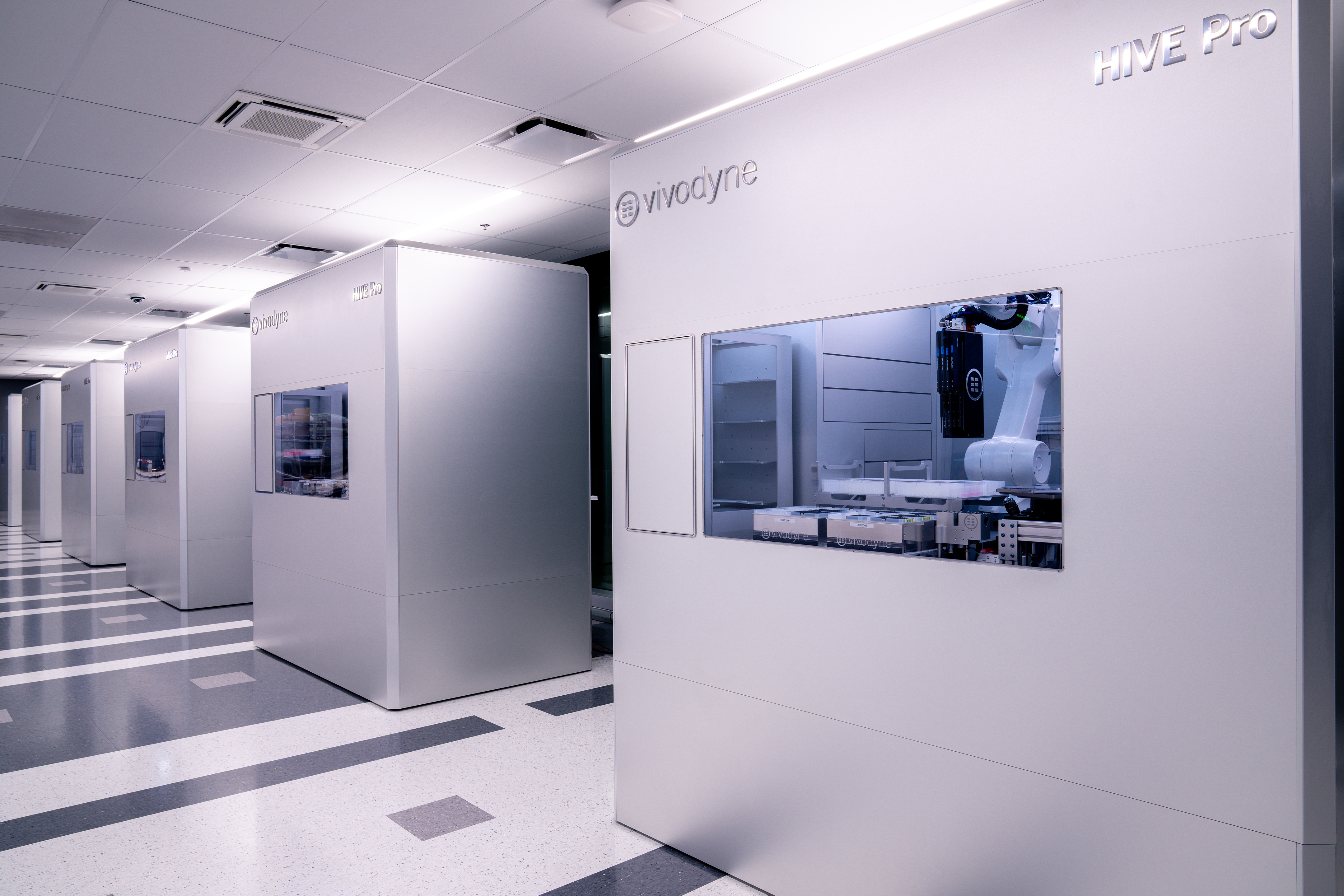
12 robotic HIVE laboratories and new wafer-scale TissueDisk give Vivodyne an annual capacity for 3.1 million living human tissue experiments
Pharmaceutical companies see what a drug does inside living human tissue before it reaches a patient, while AI gains the scaled wet lab environment needed to learn complex human biology
SAN FRANCISCO & PHILADELPHIA–(BUSINESS WIRE)–Vivodyne, the company making human biology computable at AI scale, today announced the world’s largest human biological datacenter, with 12 robotic HIVE laboratories and the annual capacity to perform controlled trials on 3.1 million large human tissues per year — estimated at twice the scale of every clinical trial in the USA combined.

The company also introduced its Series 2 TissueDisk, a wafer-scale biological chip that simultaneously grows hundreds of large, functional, living human tissues and is manufactured end-to-end on Vivodyne’s own robotic production line.
Eight of the world’s largest pharmaceutical companies have paid for early access to the platform. The goal? To discover and test new medicines ‘in humans’ before ever testing in people.
Together, the TissueDisk and Vivodyne’s robotic HIVE laboratories create something neither pharmaceutical research nor artificial intelligence has possessed before: a large-scale experimental environment in which the same reinforcement learning technique that has driven the explosion in AI language models can finally be harnessed to learn the workings of our physiology.
For pharmaceutical companies, that means learning how actual human tissue responds to a drug while decisions about targets, chemistry, dosing, and safety can still be made. Vivodyne’s approach allows millions of therapeutic interventions to be introduced into living human tissues, and their causal biological consequences measured directly with the most advanced, paired-data modalities available today: 3D scanning, transcriptomic sequencing, and deep proteomic analysis. It powers a self-driving experimentation loop, where an AI model can design massive experiments in human tissues, observe the real-world consequences, learn from the result, and optimize again and again, rather than working from static correlational data in published literature or computational predictions.
Vivodyne’s platform provides the foundation of the first world model of human biology. Previously, the controlled experiments required to reveal complex, physiological cause-and-effect could not be performed safely in patients or at nearly the needed scale. Vivodyne makes those experiments possible in living human tissue outside the body.
In this environment, the world is living human tissue. The intervention may be a drug, a novel combo regimen, or a gene therapy. The biological context may vary by donor or disease state. The consequences are measured across the tissue’s cells, blood vessels, immune components and molecular pathways.
“Superintelligence in biology is needed more than ever, because we’re running out of diseases that can be cured with the simple, single-target medicines of today,” said Andrei Georgescu, Ph.D., chief executive officer and co-founder of Vivodyne. “You cannot fix a car by turning a single screw, and the idea that the complex malfunctions in cancer, fibrosis, autoimmune disorders, or neurological disease can be fixed with a conventional single-target drug is wishful denial. We cannot keep hoping for medical miracles, and need to address the issue head-on: we do not understand human biology nearly well enough to predict exactly how to intervene. Testing in cells or animals is not enough; we don’t train our language models on whale sounds. To create AI that understands our intricate human biology, we need to continuously generate and train on huge amounts of human data, and we can’t get that by risking people. So we grow these functional human tissues by the millions instead; large, living tissues that grow their own blood vessels and immune cells and all the structures of native tissues. They mature, get diseases, bleed, scar, and, at huge scale, we learn how to make them heal. Every human response gives our AI something it cannot learn from a paper or a simulation: a living substrate to poke so that it can learn, from richer data than has ever been gathered, how it pokes back. At Vivodyne’s scale of automated human-tissue trials, all those learned consequences together become the training landscape for a world model of the human body, and the physical evidence that a pharmaceutical company needs before a drug is brought to patients.”
22 human organ systems, each a world of its own
Vivodyne grows over 20 types of different human organ tissues, both healthy and with patient-linked diseases, including liver, lungs, gut, bone marrow, pancreas, kidney, eyes, lymph nodes, and more, with disease-specific versions spanning fibrosis, site-specific solid tumors, inflammation, metabolic disorders, vascular disease, and countless others. The company trains causal, multimodal AI models on the experiments conducted within each organ type, alone and combined.
Connecting those models across organ systems builds a world model of the human body that can answer what happens when a pair of receptors is drugged, a biological pathway is interrupted, a therapy causes an unexpected side effect, how cells respond and communicate, and whether disease is aggravated, stopped, or reversed. These predictions can then be real-world tested at scale to confirm what actually happens in human tissue, and then refined and advanced.
“Computational models of human biology have largely been graded on how well they fill in data resembling information they have already seen, and that is reconstruction rather than novel prediction,” said Tony Bahinski, Ph.D., chief biotechnology officer of Vivodyne and long-standing member of the FDA’s science board. “Prediction means knowing what happens when you try something new. And in pharma, almost everything we try is new. Coding models don’t just memorize; they write and test enormous amounts of new code in their training, which is why they are so skilled today. So in kind, a biological world model can only truly learn by experimenting against complex, living human biology that can be dosed, perturbed, and allowed to recover. This training loop is what Vivodyne now makes possible at scale.”
Biological microprocessors, fully autonomous experiments
Each tissue on a Vivodyne TissueDisk functions like a biological microprocessor. Drug molecules and genetic perturbation are its input, and the living tissue computes the human response as an output.
Vivodyne manufactures TissueDisks on its own wafer-scale production line, enabling automated industrial scaling with the same exacting precision and reproducibility as semiconductor fabs.
TissueDisks run inside Vivodyne’s robotic HIVE laboratories. Each one operates automatically for weeks with full unattended automation, performing end-to-end cultivation, experimentation, and longitudinal data-gathering on tens of thousands of different tissues at a time, all containing billions of living cells. The automated labs grow tissues to maturity, deliver complex dosing regimens into their bloodstreams, perform multi-gene knockouts and activations, dose them with cell therapies or other complex modalities, capture timecourses of detailed three-dimensional scans and molecular or spatial analyses, running for weeks without human intervention.
Vivodyne’s software platform and scientific ontology, Hivemind, plans experiments, orchestrates its robotic laboratories, trains models on each result, and uses what it learns to determine which experiments should run next.
Each Vivodyne tissue starts with primary cells from human patients and grows to the size of the large medical biopsies studied by pathologists, each whole containing 200,000 to 500,000 cells of all the different types found natively. Those cells self-assemble into structures containing perfusable blood vessels, organ-specific function, and rich stroma and immune components. Because the vascular networks form through the same developmental process that produces blood vessels in the body, delivered test compounds arrive at the tissue through the bloodstream, just as they would in a patient.
This has resulted in unparalleled concordance with real human clinical results. For example, in direct comparisons to healthy and diseased patients, the cellular composition of Vivodyne airway tissue achieved a Lin’s concordance correlation coefficient of 96% with human patient airway tissue, with disease- and cell-specific gene expression indistinguishable from that seen in a typical sample of real patients.
The same system that generates training data for AI also answers the questions on which a drug program is built: it shows how new therapeutic targets causally respond in humans, which drug candidates or combinations produce the best responses, whether side-effect toxicities arise, and how donor-specific disease biology can change the outcome.
Vivodyne’s pharmaceutical programs span pulmonary tumors, multi-target biologics, cell therapies, immunosuppression, fibrosis, inflammatory disease, mRNA and lipid nanoparticles, chemotherapeutics, antibody-drug conjugates, vaccine development, and drug-induced liver injuries.
Partners have both reserved trial-scale experimental capacity within Vivodyne’s biological datacenters and increasingly work with Vivodyne on new drug-discovery programs.
“AI learned language from humanity’s entire body of written records,” Georgescu said. “It should learn medicine from the human body, too. Vivodyne is creating that human record of rich physiological data now, at the immense scale required to make human biology computable.”
Vivodyne is currently expanding data production from millions of tissues toward billions, and embedding their findings into an increasingly complete computational representation of the human body. Their mission is to restore and enhance human function.
About Vivodyne
Vivodyne makes human biology computable. The company trains medical superintelligence through robotic experimentation on millions of living, vascularized, functional human tissues that are lab-grown to the size of large clinical biopsies. Their technology produces human evidence before clinical trials, and powers AI-scale automated reinforcement learning environments where actions produce causal, clinically concordant consequences. Vivodyne’s human biological datacenters are located in the San Francisco Bay Area and Philadelphia. For more information, visit www.vivodyne.com.
Contacts
Media Contact
Patrick Schmidt, Consort Partners
[email protected]